


Think of six people in your life. Can they name all three branches of government? Can they name at least one? If you answered yes for everyone you’re thinking about, congratulations: you’re living in a bubble!
Every year for Constitution day (which is today! how are you celebrating?), the Annenberg Public Policy Center at the University of Pennsylvania releases a survey showing what the average American knows about our government. And every year, the toplines are eye-opening.
Just look at the latest findings they released this week:
Only 2/3 of people could name all three branches of the US government.
1 in 6 Americans can’t name a single branch of government.
1 in 4 surveyed can’t name a single right protected by the First Amendment.

These statistics (which just scratch the surface of what’s in the report) are a clear call to increase civic education across the country, but they’re also a stark warning for political communicators. The reality is people are busy, and anyone not getting paid to think about politics probably has 1,000 things to worry about before they think about our federal government.
With all this in mind, we need to stay focused on first principles: Naming heroes and villains, and identifying immediate, tangible impact.
On the food recalls, for example, we can’t assume that people know the Food and Drug Administration is supposed to be checking food safety before it hits the shelves, much less that the FDA is run by RFK Jr., who was nominated by Donald Trump and confirmed by Senate Republicans. We have to make those connections for people, and I’ve been glad to see accounts like Fact Post including photos of villains and the everyday activities they’re harming in their posts to really drive those connections home.

These are the associations we need to be creating every day, as often as possible, between now and Election Day. Not because voters are dumb, but because they have better things to do than remember the names of U.S. Cabinet officials.
We can get to the civics lessons later. For now, we need to play with the hand we’re dealt, check our assumptions, and make sure we’re communicating effectively about the stakes of this election for the next 47 days.
Reads Worth Your Time
Beyond the Autopsy: An 8-Part Action Plan to Reform the Democratic Party (Movement Voter PAC)
“In so many ways, insiders and outsiders alike agree that the corrupting influence of money and selfish interests has hollowed out the Democratic Party, undermined trust in the party brand, and depleted the goodwill of Democratic voters and donors — leaving the door open for demagogic charlatans to seize power. Too often, the Democratic Party feels like a technocratic, top-down, money-driven racket instead of a people-powered, mission-driven vehicle to improve our country. So we wanted to understand what we could realistically do to fix it.”
I’m hoping to do a deeper dive on this in future weeks, but this report is worth highlighting multiple times!
What Charlie Kirk’s death revealed to me, one year later (Who Broke It)
“Confusion has turned into hundreds of other feelings, practices, and states of being: bitterness, delusion, sanctimony, hypocrisy, skullduggery, glee, grift, parody, desperation… Remember that dose of clarity I promised you at the beginning of all this? It’s time to collect, and fully process the impact Charlie Kirk’s death had on our culture, one year later.”
Too many important takeaways to fit in one blurb, go read this one in full.
A New List Suggests the Most Influential Creators Aren’t the Ones You Expect (The Hollywood Reporter)
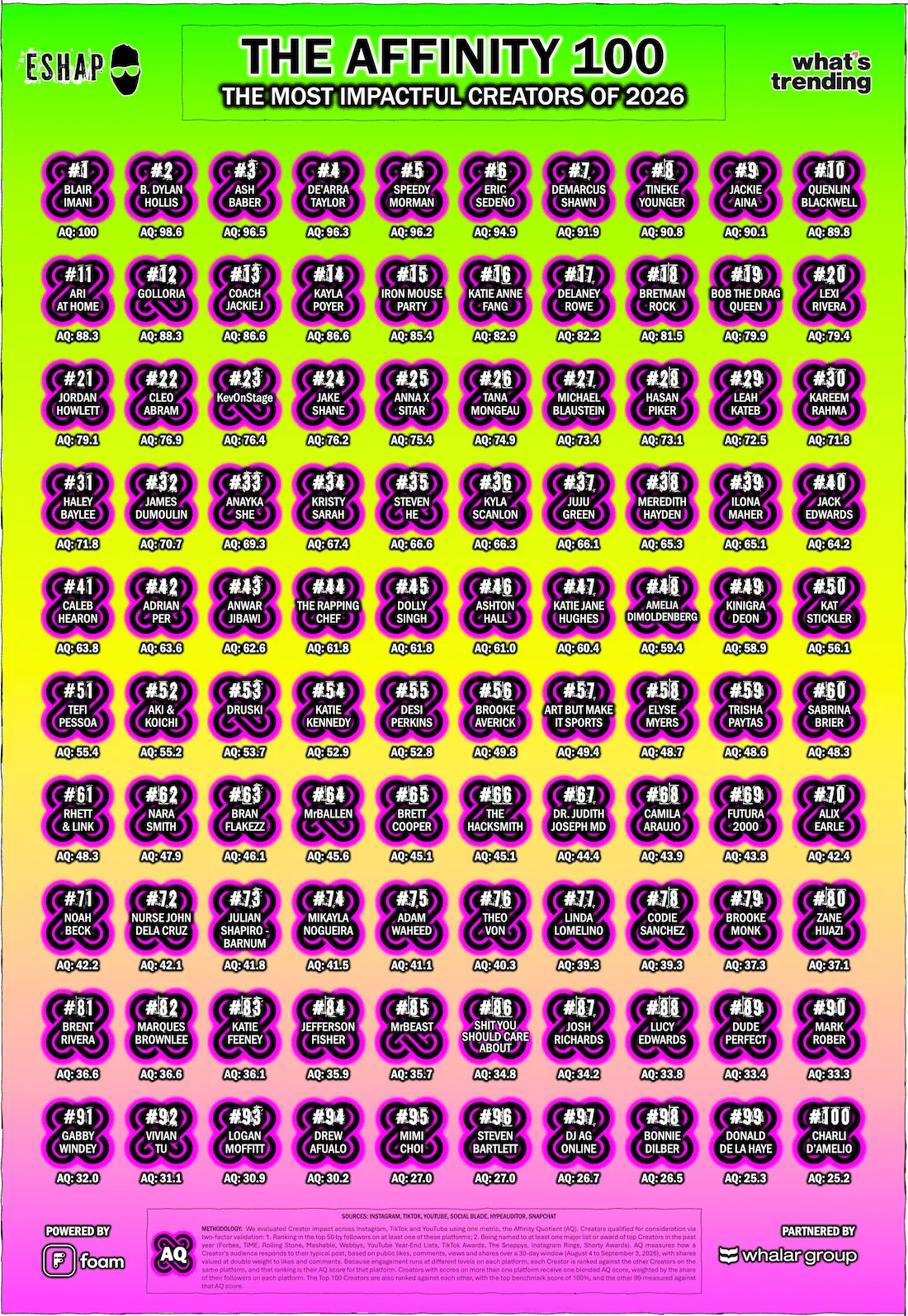
“What if the most well-known creators aren’t the most influential? A new creator Affinity List list from media executive turned “media cartographer” Evan Shapiro and What’s Trending founder Shira Lazar explore that very idea. … While there are plenty of familiar names (MrBeast is 85, Charli D’Amelio is 100, Mark Rober is 90) the top of the list is filled with creators that have much smaller — but also much more engaged — audiences.”
We Need a Connection Agenda for Young Adults (and the Rest of Us Too) (the next aGENda)
“1 in 10 young adults have no in-person contact at all on an average day. Half say they don’t have enough friends to spend time with in-person. Only 30% are dating even though half want to be in a relationship. In the last 20 years, everyone is speaking fewer words per day, but those under 25 have lost 44% more words than older adults. When half of young people don’t have connections in their community, we shouldn’t be surprised that their trust in other people has collapsed. This is a huge problem for our democracy.”
LOVE that there are real policy ideas in this piece for local and national action — not just wishful thinking!
Trend Report
INSTAGRAM IS STARTING TO ALLOW CLICKABLE LINKS IN YOUR CAPTIONS! THIS IS NOT A DRILL! Get a full breakdown from Gabriella Zutrau or directly from Instagram about how it works and what it means for organizers everywhere.
Montana Senate candidate Seth Bodnar takes aim at Flock cameras and the surveillance economy.
Big Brother winner Taylor Hale breaks down rising grocery costs and the importance of voting in the midterms.
Amazing example of talking like a real person when discussing politics!
Voting app Sway went all-out with a creator push to announce they’re offering people $500 to throw ‘ballot parties’ before Election Day.

Candidate for Ohio state representative Paul Michael Kurtz uses the new meme of Elizabeth Holmes saying “Why would I deceive you?” to call out Republicans.
Lots of juice left in this meme for people to take advantage of, both as a video or just a static image!
Candidate for Ohio Treasurer Seth Walsh shares 3 signs you’re dating a loser
Cool Tools
Looking for creative ways to build in-person community? Plurality’s Blueprints are a trove of ideas, with tips for what to do before, during, and after the event to make the most impact.
